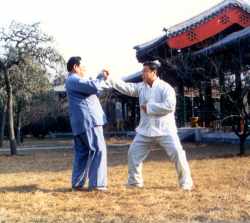
Chen style Xin Yi Hun Yuan taijiquan contains Xin Yi (consciousness intentions) as a guiding principle, the intention moves the Qi (energy), the Qi moves the body. It also contains Hun Yuan, which is the original energy stored in Dan Tian. While practicing Xin Yi Hun Yuan taijiquan the practitioner uses intention to move the original Qi from Dan Tian to circulate throughout the body, and than to return to Dan Tian.
Taijiquan contains the Chan Si (silk reeling), it is one continuous line drawn with the body, like a silk worm that uses one single thread of silk to create an entire cocoon.
Chen style Xin Yi Hun Yuan taijiquan is thus the use of intention to circulate the original Hun Yuan Qi, as to strengthen it, the body and create the Chan Si force with it.
In Taijiquan the practitioner must learn the skill of finding the stillness in the movement, and finding the movement in the stillness. Stillness and movement are Yin and Yang, Yin and Yang is Taiji.
While a movement divides into inner and outer movements, inner movement is the intention that moves the Qi through the meridians, outer one is the Qi that moves the body, the two preliminary conditions for these two movements are emptiness and stillness. Thus Chen style Xin Yi Hun Yuan taijiquan holds stillness as primary.
To exercise without nourishing the body will decline, to nourish without exercising there will be no progress.
To exercise quiescence and slow is to nourish, to exercise haste and fast is to harm.
To practice well is to nourish Qi, blood, essence and spirit. To practice wrong is to shade Qi, blood, essence and spirit.
While practicing a routine form for 10 times, 9 times should it be practiced very slowly, completely relaxed, sinking the Qi to Dan Tian, and circulating the Qi with intentions.
Only while practicing the 10th routine should Fa Jin (emitting force) be used, and strong concentration on the applications be utilized.
From head to toe, internally are Qi , spirit, essence and organs, externally are skin, muscles and bones all unite as one. It can also be divided into 3 internal unifications and 3 external ones. Three internal unifications are consciousness and intentions, intentions and Qi, Qi and force. Three external ones are hands and feet, elbows and knees, shoulders and hips. This is the entire body six unite into one.
Above and bellow has upper, middle and lower. When the arms move the legs follow, when the legs move the arms respond, when the arms and legs move the hips and spine coordinate them and act as an axis.
The upper Dan Tian controls the arms, the middle Dan Tian controls the body and the lower Dan Tian controls the legs. When the three Dan Tians unite into one, the hands legs and body all reach at the same time, and the opponent can not penetrate. When one part is moving all is moving, when one part is still all is still, when one part opens all is opening, when one part closes all is closing, above and bellow is one unified Qi.
To summarize all that, while practicing Taijiquan the intention moves the Qi, the Qi moves the body. Beyond that the essence transforms into Qi, the Qi transforms into the spirit, and the spirit returns to emptiness, a search into that will bear a big progress.
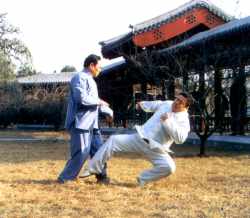
Spring, summer, fall and winter, in chinese medicine is a cycle of birth(sheng), growth(zhang), decline(shou) and storage(cang) respectively. In an auspicious year the weather is harmonious with this cycle, and illnesses among the people are few. Thus while practicing Qigong Yin and Yang, opening and closing should take and even part.
However in an inauspicious year the weather is pervasive, and illnesses among the people are often. In this case Yin and Yang, opening and closing should take their part accordingly.
Here I will bring few examples to make it clearer.
In spring when the weather is unusually cold, the birth(sheng) phase is sparse, while practicing Qigong Yang and opening should be emphasized.
In summer when the weather is cool, the growth(zhang) is being hindered, Yang and opening should dominate.
In fall when it is hot, the Yang Qi does not decline(shou) and the Yin will suffer. Yin and closing must be emphasized.
In winter when it is unusually warm, the storage(cang) phase is empty, Yin and closing must rule.