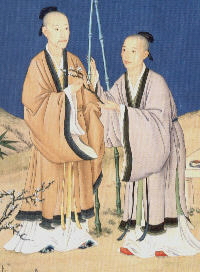
The "Yi Jing" (book of changes), or the study of "Yi" (change), is the origin of 5000 years of traditional Chinese philosophy and medicine.
Begins with legendary Xia dynasty (2500 B.C.) and the emperor Fu Xi, finding the Ba Gua( 8 trigrams) and "He Tu and Luo Shu" (the river sketch and Luo card). which depicts a set of numbers, representing the natural laws of the universe, and the change of things ( later called Yin and Yang).
common belief is that the book of changes is the "Zhou Yi",
however this is only partially true. In ancient times they were 3 classical texts, that represented 3 schools of thought.
The oldest "Lian Shan Yi"(continous mountain Yi), the second "Gui Zang Yi" (return to the origin Yi), and the third the "Zhou Yi" ( the Yi of Zhou dynasty).
The legend goes that king Wen, of the Zhou dynasty, decided to open the 8 trigrams from the trigram Qian(heaven), not like in the previous Xia and Shang dynasties, where they were opened from Gen (mountain) and Kun (earth) respectively. He thus banned the older traditions from being taught, till the Han dynasty (220 B.C.) where they became extinct
In later days the "Lian Shan Yi" school of thought , was represented by the classic "Tai Xuan Jing" (the great mysterious classic), and the "Gui Zang Yi" by the classic "Yuan Bao Jing" (the origin surrounds classic).
One example representing the difference in the numerology of the "Zhou Yi" and the "Lian Shan Yi":
"Zhou Yi": One (Taiji) divides into two (Yin and Yang) , Two divides into four (seasons), four divides into Eight (trigrams).
"Lian Shan Yi": One divides into two, two into three, three into nine, and nine into eighty one.
The father of Daoism Lao Tzi (650 B.C.) in his classic "Dao De Jing" said: " one divides into two, two divides into three, and three create myriad things."
This concept is clearly a "Lian Shan Yi" paradigm.
However different, all schools of "yi" have common grounds, which is the truth of "Yi" (change).
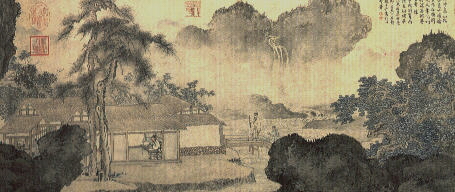
Influenced by the moon and the sun, the stars and the seasons, the ancient sages have realized that change is the force of life. Thus nothing can go without it. we are born and die, we are active and a sleep, we are happy and sad. This is "Dao"( the way things are). The "Dao" , in turn, represents everything the way it should be: the man is vibrant and active, the stones and rocks are still and quiet, the river flows and the sea is endless.
Out of this perception springs the Chinese medicine. It is the 5000 years of research into the natural force of the universe, the " Dao" of things, and the harmony between man and nature.
It is the art of keeping oneself healthy, rather than curing its illnesses.
It is observing nature (heaven, earth and man), as to act by its laws.
In literature, the origin of chinese medicine is in the "Huang Di Nei Jing" (the internal classic of the yellow emperor, ca. 800-200 B.C.). Which rely entirely on the study of "Yi", and for itself is one of the most important works about it. So to say Yin and Yang, Five elements (wood, fire, earth, metal and water), Meridians etc. are all theories rooted well into the understanding of "Yi".
Zhang Zhong Jing (ca. 250 B.C.), in his work "Shang Han Za Bing Lun" (treatise on cold induced and miscellaneous diseases), discusses the theory of "Liu Jing" (six divisions), which, originally, is brought for by the "Internal Classic of the Yellow emperor". In his work, he expresses the solutions to various illnesses via the numerology of the "Yi" , using specific quantities of herbs, representing special forces of the universe, to compose prescriptions.
for example: the numbers 3 and 8 are in the east and represent spring and growth. 4 and 9 are in the west and represent fall and decline.
Thus utilizing the study of "Yi" to develop the study of medicine.
So saying, we realize that the traditional Chinese medicine and the study of "Yi" are inseparable. And to understand the Chinese medicine one must search the "Yi".